# Reuse, providers, credentials
Share one definition between instances, pass a provider in as an input, and keep a credential out of the state.
Level: intermediate · Time: 20 minutes · Needs: B5
You will learn: How does a shared definition receive a provider? Where does a credential go?
Done when: A definition builds its resources through providers that the root passes in. A secret reaches a provider without reaching the state.
In OpenTofu, code is reused through a module: a directory with its own variables and outputs, called with a `module` block. pravo has no module block. A definition that contains resources does that work. The caller writes an instance, and the fields of the definition are its inputs, its outputs and its providers alike. The word module means one thing in pravo: a CUE module, the tree of packages under `cue.mod/module.cue` that import paths start with. [A13](a13-packages-and-the-standard-library.md) wrote one.
Two questions come with a shared definition. How does it get its provider? Where does a credential go?
In OpenTofu a module reaches its provider through a `providers` map on the module call. The module's inputs sit in another place. A `sensitive` variable is hidden from the plan output. It is still written to the state when a resource attribute uses it.
:::compare
```hcl title="main.tf"
provider "local" {
alias = "primary"
}
module "api" {
source = "./modules/service"
providers = { local = local.primary }
name = "api"
port = 8080
}
```
```cue title="main.cue"
api: service.#Service & {
local: $local
name: "api"
port: 8080
}
```
:::
The definition contains the resources. A provider is a value, so the definition takes it as an input field, next to the other inputs, and marks the field required with `!`. The caller fills the field with a provider.
A credential belongs to the provider, and pravo checks where it goes. A secret that reaches provider configuration is never recorded. A secret that reaches a resource attribute is refused at plan. This lesson writes a definition in a package of its own, uses it twice and passes it providers. Then it puts a secret in each of the two places and shows what pravo does.
:::figure The root owns the providers. Each one goes into an input field of the instance. The definition builds its resources through the inputs.
:::
## Write the definition
Work in an empty directory. The definition goes in a package of its own, so that any root can import it. An import of your own package starts with the name of the CUE module, the first line of `cue.mod/module.cue`. `pravo init` writes that file with a name taken from the directory. Here you write it first, so that the name is `example.com/estate`.
```cue file=cue.mod/module.cue title="cue.mod/module.cue"
module: "example.com/estate@v0"
language: version: "v0.14.0"
```
The package `service` holds the definition.
```cue file=lib/service/service.cue title="lib/service/service.cue" hl="9-10,12-13,15-20"
package service
import (
loc "pravo.dev/providers/hashicorp/local"
rnd "pravo.dev/providers/hashicorp/random"
)
#Service: {
random!: rnd.#Provider
local!: loc.#Provider
name: string & =~"^[a-z][a-z0-9-]*$"
port: int & >1024 & <65536
serial: random.#Resource.random_integer & {min: 1000, max: 9999, seed: name}
config: local.#Resource.local_file & {
filename: "out/\(name).conf"
content: "service \(name)\nport \(port)\nserial \(serial.result)\n"
}
}
```
Three parts matter here.
- `random` and `local` are provider inputs. Their type is the generated `#Provider` of each package. The `!` makes each one required: an instance that leaves one out is an error.
- `name` and `port` are inputs with constraints, as in [A5](a05-constraints-narrow-a-value.md).
- `serial` and `config` are resources, built through the provider inputs. The seed makes the serial repeatable. `config` reads `serial`, so pravo creates `serial` first.
The root decides the version and the configuration of each provider it passes in.
## Use it twice
The root declares each provider once and passes it in.
```cue file=main.cue title="main.cue" hl="9-10,12-13"
package main
import (
loc "pravo.dev/providers/hashicorp/local"
rnd "pravo.dev/providers/hashicorp/random"
"example.com/estate/lib/service"
)
$random: rnd.#Provider
$local: loc.#Provider
api: service.#Service & {random: $random, local: $local, name: "api", port: 8080}
worker: service.#Service & {random: $random, local: $local, name: "worker", port: 9090}
```
```sh run
pravo init
pravo validate
```
```text out
Configuration does not load yet; generating schemas for the declared providers first.
Providers:
local = hashicorp/local v2.9.1
random = hashicorp/random v3.9.1
Up to date cue.mod/gen/pravo.dev/providers/hashicorp/local (2 resource types, 3 data sources, 1 ephemeral, 1 functions)
Up to date cue.mod/gen/pravo.dev/providers/hashicorp/random (10 resource types, 0 data sources, 2 ephemeral, 0 functions)
pravo has been initialised. Run "pravo plan" to see what it would do.
Success! 4 resources, 0 data sources, 0 ephemeral, 0 function calls, 0 outputs across 2 providers.
```
:::predict What is the address of the file that api builds?
A resource's address is the path where its struct sits. The instance is `api`, and the file is a field of it.
::reveal
The address is `api.config`. The serial is `api.serial`. The worker has `worker.config` and `worker.serial`.
:::
Apply the root and list what the state holds.
```sh run
pravo apply --auto-approve
pravo state list
```
```text out
pravo will perform the following actions:
# api.serial (random_integer) will be created
+ api: serial: {
+ id: (known after apply)
+ max: 9999
+ min: 1000
+ result: (known after apply)
+ seed: "api"
}
...
Plan: 4 to add, 0 to change, 0 to destroy.
Graph: planned 4
...
Apply complete! Resources: 4 added, 0 changed, 0 destroyed. [txn ]
api.config
api.serial
worker.config
worker.serial
```
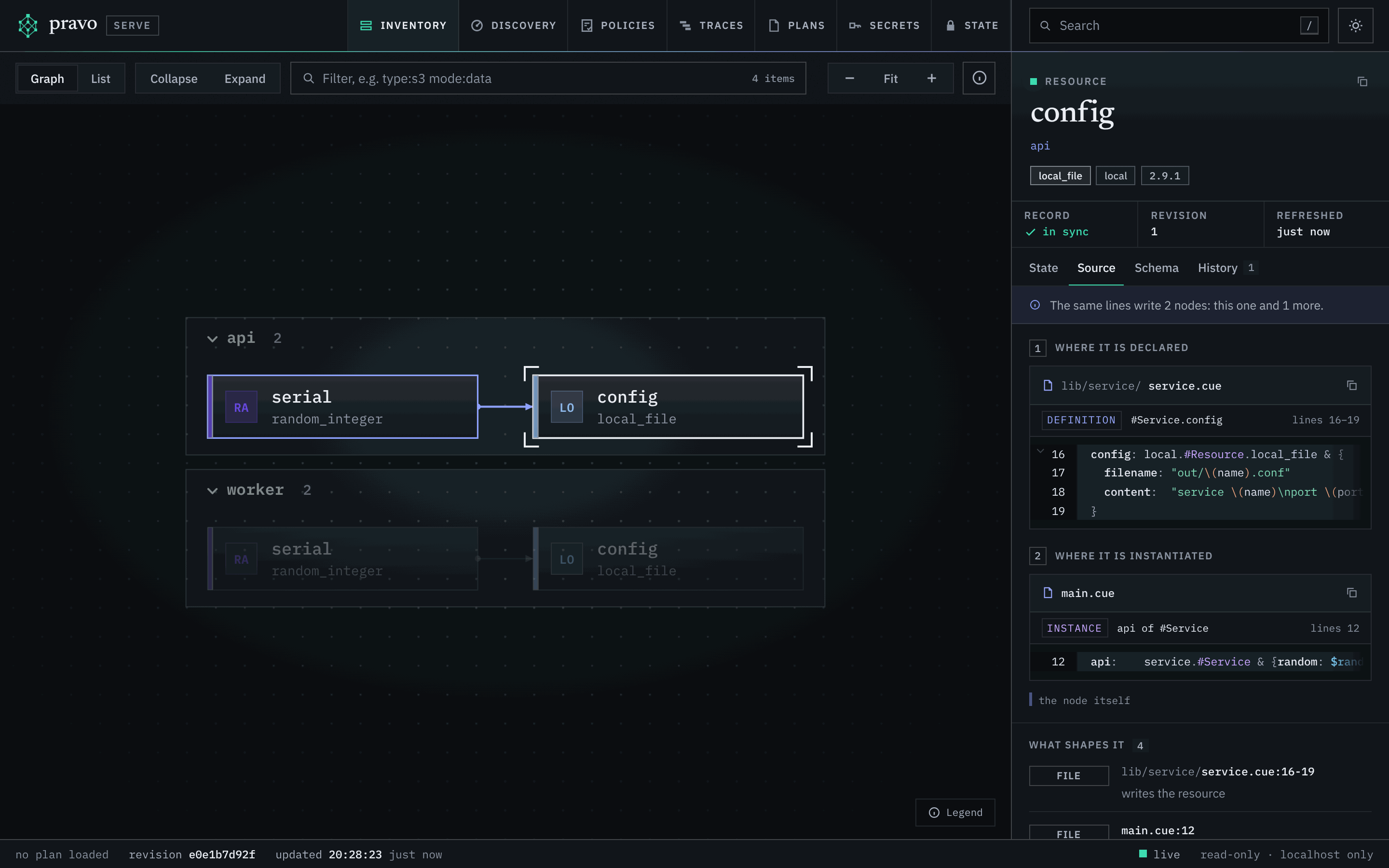
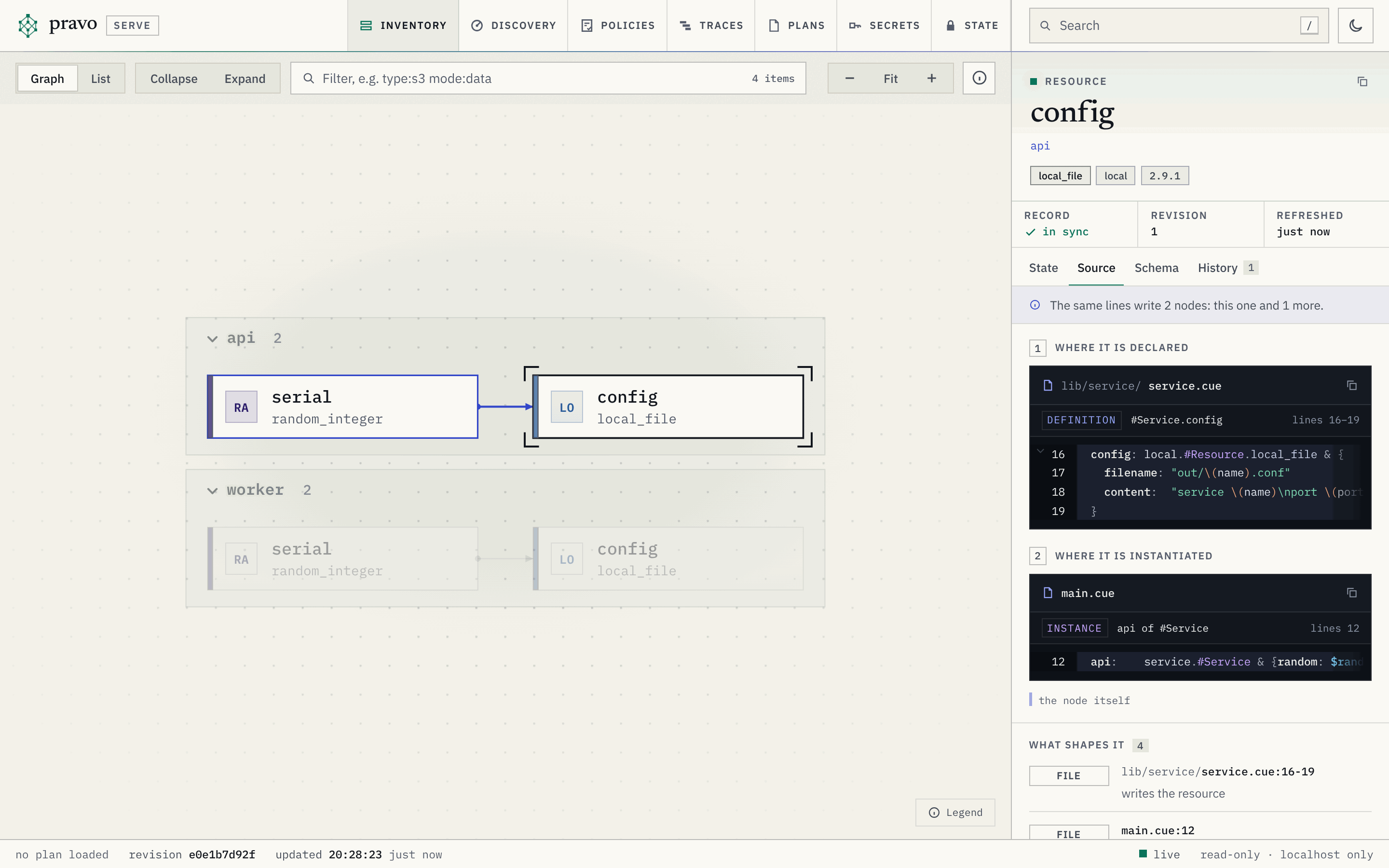
In the viewer, `pravo serve` from the root, each instance is a group with its two resources, and the Source tab of `api.config` has two places: where the definition declares the file, in the package, and where the root instantiates the definition as `api`.
:::figure `api.config` in the viewer. Its source has two places: the definition in the package, and the instance in the root.
:::
Each instance wrote its own file.
```sh run
cat out/api.conf out/worker.conf
```
```text out
service api
port 8080
serial 2680
service worker
port 9090
serial 2481
```
Each instance has its own name, port and serial. They share the definition and nothing else.
## Break it: a wrong provider
A provider input is typed. This root passes the random provider where the definition expects the local one. The block carries `status=rejected`: pravo refuses it before any provider starts.
```cue file=main.cue title="main.cue" status=rejected hl="12"
package main
import (
loc "pravo.dev/providers/hashicorp/local"
rnd "pravo.dev/providers/hashicorp/random"
"example.com/estate/lib/service"
)
$random: rnd.#Provider
$local: loc.#Provider
api: service.#Service & {random: $random, local: $random, name: "api", port: 8080}
worker: service.#Service & {random: $random, local: $local, name: "worker", port: 9090}
```
```sh run exit=6
pravo validate
```
```text out
Error: evaluating .:
api.local.$source: conflicting values "registry.opentofu.org/hashicorp/local" and "registry.opentofu.org/hashicorp/random":
./cue.mod/gen/pravo.dev/providers/hashicorp/local/local_gen.cue:23:11
./cue.mod/gen/pravo.dev/providers/hashicorp/random/random_gen.cue:23:11
./lib/service/service.cue:10:11
./main.cue:12:9
./main.cue:12:53
```
The path is `api.local.$source`, the identity of the provider. The two values are the sources of `local` and `random`. The locations name the generated packages, the instance in `main.cue` and the input in the definition.
An input constraint fails in the same way. Restore the provider and set a port below 1025.
```cue file=main.cue title="main.cue" status=rejected hl="12"
package main
import (
loc "pravo.dev/providers/hashicorp/local"
rnd "pravo.dev/providers/hashicorp/random"
"example.com/estate/lib/service"
)
$random: rnd.#Provider
$local: loc.#Provider
api: service.#Service & {random: $random, local: $local, name: "api", port: 80}
worker: service.#Service & {random: $random, local: $local, name: "worker", port: 9090}
```
```sh run exit=6
pravo validate
```
```text out
Error: evaluating .:
api.port: invalid value 80 (out of bound >1024):
./lib/service/service.cue:13:14
./main.cue:12:80
```
The error points at the bound in the definition and at the value in the root. Write the working root again to continue.
```cue file=main.cue title="main.cue"
package main
import (
loc "pravo.dev/providers/hashicorp/local"
rnd "pravo.dev/providers/hashicorp/random"
"example.com/estate/lib/service"
)
$random: rnd.#Provider
$local: loc.#Provider
api: service.#Service & {random: $random, local: $local, name: "api", port: 8080}
worker: service.#Service & {random: $random, local: $local, name: "worker", port: 9090}
```
## Credentials belong to the provider
Put a credential on the provider in the root, not in the definition. The `tls` provider has no account, but its `proxy` block takes a user name and a password. It stands in for a cloud provider here.
`pravo.#SecretEnv` reads a variable of the environment. Its value is ephemeral: it lives for one run. It may go into provider configuration and nowhere that is recorded. A state that is sealed, as Track C seals one, can keep the secret itself, with a history of who set it; [Store secrets in the sealed state](../how-to/store-secrets-in-the-state.md) shows that.
Add a third provider input to the definition, and a key that uses it.
```cue file=lib/service/service.cue title="lib/service/service.cue" hl="6,12,18"
package service
import (
loc "pravo.dev/providers/hashicorp/local"
rnd "pravo.dev/providers/hashicorp/random"
tlsp "pravo.dev/providers/hashicorp/tls"
)
#Service: {
random!: rnd.#Provider
local!: loc.#Provider
tls!: tlsp.#Provider
name: string & =~"^[a-z][a-z0-9-]*$"
port: int & >1024 & <65536
serial: random.#Resource.random_integer & {min: 1000, max: 9999, seed: name}
key: tls.#Resource.tls_private_key & {algorithm: "ECDSA", ecdsa_curve: "P256"}
config: local.#Resource.local_file & {
filename: "out/\(name).conf"
content: "service \(name)\nport \(port)\nserial \(serial.result)\n"
}
}
```
The root builds the `tls` provider with the secret and passes it to both instances.
```cue file=main.cue title="main.cue" hl="11,15-21,23-24"
package main
import (
"pravo.dev/pravo"
loc "pravo.dev/providers/hashicorp/local"
rnd "pravo.dev/providers/hashicorp/random"
tlsp "pravo.dev/providers/hashicorp/tls"
"example.com/estate/lib/service"
)
token: pravo.#SecretEnv & {name: "REGISTRY_TOKEN"}
$random: rnd.#Provider
$local: loc.#Provider
$tls: tlsp.#Provider & {
proxy: [{
url: "http://proxy.internal:3128"
username: "deploy"
password: token.value
}]
}
api: service.#Service & {random: $random, local: $local, tls: $tls, name: "api", port: 8080}
worker: service.#Service & {random: $random, local: $local, tls: $tls, name: "worker", port: 9090}
```
The new import needs the generated package of the `tls` provider.
```sh run
pravo init
```
```text out
Configuration does not load yet; generating schemas for the declared providers first.
Providers:
local = hashicorp/local v2.9.1
random = hashicorp/random v3.9.1
tls = hashicorp/tls v4.4.2
Up to date cue.mod/gen/pravo.dev/providers/hashicorp/local (2 resource types, 3 data sources, 1 ephemeral, 1 functions)
Up to date cue.mod/gen/pravo.dev/providers/hashicorp/random (10 resource types, 0 data sources, 2 ephemeral, 0 functions)
Up to date cue.mod/gen/pravo.dev/providers/hashicorp/tls (4 resource types, 2 data sources, 2 ephemeral, 0 functions)
pravo has been initialised. Run "pravo plan" to see what it would do.
```
The variable is not set. The run stops and names it.
```sh run exit=1
pravo plan
```
```text out
Error: token: the environment variable REGISTRY_TOKEN is not set
```
Set the variable for one command and apply. The value is a placeholder.
```sh run
REGISTRY_TOKEN=placeholder-secret pravo apply --auto-approve
```
```text out
...
# api.key (tls_private_key) will be created
+ api: key: {
+ algorithm: "ECDSA"
+ ecdsa_curve: "P256"
+ id: (known after apply)
+ private_key_openssh: (sensitive)
+ private_key_pem: (sensitive)
+ private_key_pem_pkcs8: (sensitive)
+ public_key_fingerprint_md5: (known after apply)
+ public_key_fingerprint_sha256: (known after apply)
+ public_key_openssh: (known after apply)
+ public_key_pem: (known after apply)
+ rsa_bits: 2048
}
...
Plan: 2 to add, 0 to change, 0 to destroy.
Graph: planned 2 · skipped 4 · not read 4
...
Apply complete! Resources: 2 added, 0 changed, 0 destroyed. [txn ]
```
The run read the variable and used it in the provider configuration. Search the state directory for the value.
```sh run
grep -r placeholder-secret pravo.state || echo "not found"
```
```text out
not found
```
## Break it: a leaked secret
Write the secret into a file. The block carries `status=rejected`.
```cue file=main.cue title="main.cue" status=rejected hl="25"
package main
import (
"pravo.dev/pravo"
loc "pravo.dev/providers/hashicorp/local"
rnd "pravo.dev/providers/hashicorp/random"
tlsp "pravo.dev/providers/hashicorp/tls"
"example.com/estate/lib/service"
)
token: pravo.#SecretEnv & {name: "REGISTRY_TOKEN"}
$random: rnd.#Provider
$local: loc.#Provider
$tls: tlsp.#Provider & {
proxy: [{
url: "http://proxy.internal:3128"
username: "deploy"
password: token.value
}]
}
api: service.#Service & {random: $random, local: $local, tls: $tls, name: "api", port: 8080}
worker: service.#Service & {random: $random, local: $local, tls: $tls, name: "worker", port: 9090}
leak: $local.#Resource.local_file & {filename: "out/leak.txt", content: token.value}
```
```sh run exit=1
REGISTRY_TOKEN=placeholder-secret pravo plan
```
```text out
Error: leak.content: references token, but ephemeral values may only be used in write-only attributes, provider configuration and other ephemeral resources (anything else is recorded in state)
```
The message names the field, the secret and the rule. The content of a file is recorded in the state, so an ephemeral value cannot go there. A write-only attribute is one that a provider accepts and never returns, so nothing is recorded for it. An output is recorded too, so the same rule stops it. Delete the `leak` line to continue.
## Break it: a provider that was not passed
An input marked `!` has no default. Add a third instance and leave out `tls`. The block carries `status=rejected`.
```cue file=main.cue title="main.cue" status=rejected hl="25"
package main
import (
"pravo.dev/pravo"
loc "pravo.dev/providers/hashicorp/local"
rnd "pravo.dev/providers/hashicorp/random"
tlsp "pravo.dev/providers/hashicorp/tls"
"example.com/estate/lib/service"
)
token: pravo.#SecretEnv & {name: "REGISTRY_TOKEN"}
$random: rnd.#Provider
$local: loc.#Provider
$tls: tlsp.#Provider & {
proxy: [{
url: "http://proxy.internal:3128"
username: "deploy"
password: token.value
}]
}
api: service.#Service & {random: $random, local: $local, tls: $tls, name: "api", port: 8080}
worker: service.#Service & {random: $random, local: $local, tls: $tls, name: "worker", port: 9090}
docs: service.#Service & {random: $random, local: $local, name: "docs", port: 8081}
```
```sh run exit=6
pravo validate
pravo plan
```
```text out
Error: provider docs.tls was not supplied: docs requires a hashicorp/tls provider in its field tls. Pass one, for example
docs: ... & {tls: $tls}
Error: provider docs.tls was not supplied: docs requires a hashicorp/tls provider in its field tls. Pass one, for example
docs: ... & {tls: $tls}
```
The message names the instance, `docs`, and the field, `tls`. The specification does not load, so no provider starts, and every command that loads it stops with the same error. Pass the provider to the instance.
```cue file=main.cue title="main.cue" hl="25"
package main
import (
"pravo.dev/pravo"
loc "pravo.dev/providers/hashicorp/local"
rnd "pravo.dev/providers/hashicorp/random"
tlsp "pravo.dev/providers/hashicorp/tls"
"example.com/estate/lib/service"
)
token: pravo.#SecretEnv & {name: "REGISTRY_TOKEN"}
$random: rnd.#Provider
$local: loc.#Provider
$tls: tlsp.#Provider & {
proxy: [{
url: "http://proxy.internal:3128"
username: "deploy"
password: token.value
}]
}
api: service.#Service & {random: $random, local: $local, tls: $tls, name: "api", port: 8080}
worker: service.#Service & {random: $random, local: $local, tls: $tls, name: "worker", port: 9090}
docs: service.#Service & {random: $random, local: $local, tls: $tls, name: "docs", port: 8081}
```
```sh run
REGISTRY_TOKEN=placeholder-secret pravo apply --auto-approve
```
```text out
...
# docs.key (tls_private_key) will be created
...
Plan: 3 to add, 0 to change, 0 to destroy.
Graph: planned 3 · skipped 6 · not read 6
...
Apply complete! Resources: 3 added, 0 changed, 0 destroyed. [txn ]
```
The state names the provider that built each key.
```sh run
pravo state show api.key | head -n 1
pravo state show docs.key | head -n 1
```
```text out
// api.key (provider registry.opentofu.org/hashicorp/tls v4.4.2 as tls, schema version 1, revision 1)
// docs.key (provider registry.opentofu.org/hashicorp/tls v4.4.2 as tls, schema version 1, revision 1)
```
Both keys were built through `tls`, the one provider struct of the root.
> [!PITFALL]
> Write `!` on every provider input. A provider field without it is a provider struct of its own, and an instance that leaves it out builds through a second provider with no configuration. Nothing fails. [Pitfalls](../migrate/m9-pitfalls.md#a-provider-that-was-not-passed) shows the run.
## Exercise
:::exercise Give docs a provider of its own
Declare a second `tls` provider in the root, `$tlsDocs`, with no proxy. Pass it to `docs` and to nothing else. Ask `pravo why docs.key` what the plan does about it. Then apply and read the provider key of `docs.key`.
::hint
`pravo why docs.key` plans the root and prints the reasons for one address. See [B2](b02-reading-a-plan.md).
::hint
`pravo state show docs.key` prints the provider key on its first line. See [B3](b03-apply-outputs-state.md) for `pravo state show`.
::solution
```cue file=main.cue title="main.cue"
package main
import (
"pravo.dev/pravo"
loc "pravo.dev/providers/hashicorp/local"
rnd "pravo.dev/providers/hashicorp/random"
tlsp "pravo.dev/providers/hashicorp/tls"
"example.com/estate/lib/service"
)
token: pravo.#SecretEnv & {name: "REGISTRY_TOKEN"}
$random: rnd.#Provider
$local: loc.#Provider
$tls: tlsp.#Provider & {
proxy: [{
url: "http://proxy.internal:3128"
username: "deploy"
password: token.value
}]
}
$tlsDocs: tlsp.#Provider
api: service.#Service & {random: $random, local: $local, tls: $tls, name: "api", port: 8080}
worker: service.#Service & {random: $random, local: $local, tls: $tls, name: "worker", port: 9090}
docs: service.#Service & {random: $random, local: $local, tls: $tlsDocs, name: "docs", port: 8081}
```
With two `tls` structs, the provider key of a resource names its struct. The plan proposes no change to the object. It reports that the provider instance differs from the recorded one.
```sh run
REGISTRY_TOKEN=placeholder-secret pravo why docs.key
```
```text out
docs.key: no-op
- provider instance changed (tls -> tls.$tlsDocs)
- refreshed because the record is older than its refresh age; no drift
```
The apply records the new provider key. It does not touch the object.
```sh run check
REGISTRY_TOKEN=placeholder-secret pravo apply --auto-approve
pravo state show docs.key | head -n 1 | grep -q 'as tls.\$tlsDocs,'
```
:::
## Clean up
```sh run
REGISTRY_TOKEN=placeholder-secret pravo destroy --auto-approve | tail -n 1
```
```text out
Destroy complete! Resources: 0 added, 0 changed, 9 destroyed. [txn ]
```
## Recap
- There is no module block. A definition that contains resources is the unit of reuse. The field that holds an instance is the prefix of its addresses.
- A provider is a required input, `provider!: pkg.#Provider`. The root passes it in, and the definition builds its resources through it. An instance that leaves it out stops the load and the message names the instance and the field.
- A credential belongs to the provider in the root. `pravo.#SecretEnv` reaches provider configuration and never the state.
:::check
Where does the version of a provider go when a shared definition builds through it?
::answer
On the provider struct in the root. The definition only declares the input.
What happens when an instance leaves out a required provider input?
::answer
The specification does not load. The error is `provider docs.tls was not supplied`, with the instance and the field.
:::
Cloud providers follow the same pattern: configure the provider in the root and pass it in. The how-to pages cover credentials, registries and sharing: [Secrets](../how-to/secrets.md), [Providers from a registry](../how-to/providers-from-a-registry.md), [Share code between roots in one repository](../how-to/share-code-between-roots.md) and [Publish a CUE module](../how-to/publishing-a-module.md).
[B7](b07-changing-live-infrastructure.md) saves a plan and applies it in stages.
 :::
Each instance wrote its own file.
```sh run
cat out/api.conf out/worker.conf
```
```text out
service api
port 8080
serial 2680
service worker
port 9090
serial 2481
```
Each instance has its own name, port and serial. They share the definition and nothing else.
## Break it: a wrong provider
A provider input is typed. This root passes the random provider where the definition expects the local one. The block carries `status=rejected`: pravo refuses it before any provider starts.
```cue file=main.cue title="main.cue" status=rejected hl="12"
package main
import (
loc "pravo.dev/providers/hashicorp/local"
rnd "pravo.dev/providers/hashicorp/random"
"example.com/estate/lib/service"
)
$random: rnd.#Provider
$local: loc.#Provider
api: service.#Service & {random: $random, local: $random, name: "api", port: 8080}
worker: service.#Service & {random: $random, local: $local, name: "worker", port: 9090}
```
```sh run exit=6
pravo validate
```
```text out
Error: evaluating .:
api.local.$source: conflicting values "registry.opentofu.org/hashicorp/local" and "registry.opentofu.org/hashicorp/random":
./cue.mod/gen/pravo.dev/providers/hashicorp/local/local_gen.cue:23:11
./cue.mod/gen/pravo.dev/providers/hashicorp/random/random_gen.cue:23:11
./lib/service/service.cue:10:11
./main.cue:12:9
./main.cue:12:53
```
The path is `api.local.$source`, the identity of the provider. The two values are the sources of `local` and `random`. The locations name the generated packages, the instance in `main.cue` and the input in the definition.
An input constraint fails in the same way. Restore the provider and set a port below 1025.
```cue file=main.cue title="main.cue" status=rejected hl="12"
package main
import (
loc "pravo.dev/providers/hashicorp/local"
rnd "pravo.dev/providers/hashicorp/random"
"example.com/estate/lib/service"
)
$random: rnd.#Provider
$local: loc.#Provider
api: service.#Service & {random: $random, local: $local, name: "api", port: 80}
worker: service.#Service & {random: $random, local: $local, name: "worker", port: 9090}
```
```sh run exit=6
pravo validate
```
```text out
Error: evaluating .:
api.port: invalid value 80 (out of bound >1024):
./lib/service/service.cue:13:14
./main.cue:12:80
```
The error points at the bound in the definition and at the value in the root. Write the working root again to continue.
```cue file=main.cue title="main.cue"
package main
import (
loc "pravo.dev/providers/hashicorp/local"
rnd "pravo.dev/providers/hashicorp/random"
"example.com/estate/lib/service"
)
$random: rnd.#Provider
$local: loc.#Provider
api: service.#Service & {random: $random, local: $local, name: "api", port: 8080}
worker: service.#Service & {random: $random, local: $local, name: "worker", port: 9090}
```
## Credentials belong to the provider
Put a credential on the provider in the root, not in the definition. The `tls` provider has no account, but its `proxy` block takes a user name and a password. It stands in for a cloud provider here.
`pravo.#SecretEnv` reads a variable of the environment. Its value is ephemeral: it lives for one run. It may go into provider configuration and nowhere that is recorded. A state that is sealed, as Track C seals one, can keep the secret itself, with a history of who set it; [Store secrets in the sealed state](../how-to/store-secrets-in-the-state.md) shows that.
Add a third provider input to the definition, and a key that uses it.
```cue file=lib/service/service.cue title="lib/service/service.cue" hl="6,12,18"
package service
import (
loc "pravo.dev/providers/hashicorp/local"
rnd "pravo.dev/providers/hashicorp/random"
tlsp "pravo.dev/providers/hashicorp/tls"
)
#Service: {
random!: rnd.#Provider
local!: loc.#Provider
tls!: tlsp.#Provider
name: string & =~"^[a-z][a-z0-9-]*$"
port: int & >1024 & <65536
serial: random.#Resource.random_integer & {min: 1000, max: 9999, seed: name}
key: tls.#Resource.tls_private_key & {algorithm: "ECDSA", ecdsa_curve: "P256"}
config: local.#Resource.local_file & {
filename: "out/\(name).conf"
content: "service \(name)\nport \(port)\nserial \(serial.result)\n"
}
}
```
The root builds the `tls` provider with the secret and passes it to both instances.
```cue file=main.cue title="main.cue" hl="11,15-21,23-24"
package main
import (
"pravo.dev/pravo"
loc "pravo.dev/providers/hashicorp/local"
rnd "pravo.dev/providers/hashicorp/random"
tlsp "pravo.dev/providers/hashicorp/tls"
"example.com/estate/lib/service"
)
token: pravo.#SecretEnv & {name: "REGISTRY_TOKEN"}
$random: rnd.#Provider
$local: loc.#Provider
$tls: tlsp.#Provider & {
proxy: [{
url: "http://proxy.internal:3128"
username: "deploy"
password: token.value
}]
}
api: service.#Service & {random: $random, local: $local, tls: $tls, name: "api", port: 8080}
worker: service.#Service & {random: $random, local: $local, tls: $tls, name: "worker", port: 9090}
```
The new import needs the generated package of the `tls` provider.
```sh run
pravo init
```
```text out
Configuration does not load yet; generating schemas for the declared providers first.
Providers:
local = hashicorp/local v2.9.1
random = hashicorp/random v3.9.1
tls = hashicorp/tls v4.4.2
Up to date cue.mod/gen/pravo.dev/providers/hashicorp/local (2 resource types, 3 data sources, 1 ephemeral, 1 functions)
Up to date cue.mod/gen/pravo.dev/providers/hashicorp/random (10 resource types, 0 data sources, 2 ephemeral, 0 functions)
Up to date cue.mod/gen/pravo.dev/providers/hashicorp/tls (4 resource types, 2 data sources, 2 ephemeral, 0 functions)
pravo has been initialised. Run "pravo plan" to see what it would do.
```
The variable is not set. The run stops and names it.
```sh run exit=1
pravo plan
```
```text out
Error: token: the environment variable REGISTRY_TOKEN is not set
```
Set the variable for one command and apply. The value is a placeholder.
```sh run
REGISTRY_TOKEN=placeholder-secret pravo apply --auto-approve
```
```text out
...
# api.key (tls_private_key) will be created
+ api: key: {
+ algorithm: "ECDSA"
+ ecdsa_curve: "P256"
+ id: (known after apply)
+ private_key_openssh: (sensitive)
+ private_key_pem: (sensitive)
+ private_key_pem_pkcs8: (sensitive)
+ public_key_fingerprint_md5: (known after apply)
+ public_key_fingerprint_sha256: (known after apply)
+ public_key_openssh: (known after apply)
+ public_key_pem: (known after apply)
+ rsa_bits: 2048
}
...
Plan: 2 to add, 0 to change, 0 to destroy.
Graph: planned 2 · skipped 4 · not read 4
...
Apply complete! Resources: 2 added, 0 changed, 0 destroyed. [txn