
§ B10 · Track B · pravo
Find what nothing manages
Declare a discovery over a region, run it, acknowledge the objects that are meant to stay, adopt one into the specification and check the rest from a pipeline.
On this page
Someone made a server from the console a year ago, and a job starts two more every night. No specification names them. Which command lists them, and how do you take one over?
A specification names what pravo manages. A cloud holds more: objects made by hand, by a job, or by a specification that nobody runs. In OpenTofu you learn the id of such an object elsewhere, in the console or from the command line of the cloud, and write an import block for it. pravo has a discovery: a struct of the specification that lists the objects of one type in a scope, sets them against the state and shows the ones that no record accounts for. Discovery explains how an object is told from the others.
tofu import demo_server.web_old srv-web-old
pravo discover
pravo discover adopt servers srv-web-old --read
A discovery needs a provider that can list. This lesson uses one that stands in for a cloud: tools/fakeprovider in the source tree of pravo, which keeps its objects in a JSON file. Its type demo_server has a name and a size, and the provider can list the servers of a region. Nothing on this page needs an account.
Build the provider
Work in an empty directory. The provider is built from a checkout of pravo with the Go tool, into the directory of this lesson, which the command below calls ~/b10.
go build -o ~/b10/terraform-provider-demo ./tools/fakeprovider
The provider reads its cloud from a file. Write four servers into it, as if three had been made by hand in the region eu and one in us, and tell the provider where the file is. A real provider takes credentials in the same place.
[
  {"id": "srv-web-old", "name": "web-old", "region": "eu"},
  {"id": "srv-batch-1", "name": "batch-1", "region": "eu"},
  {"id": "srv-batch-2", "name": "batch-2", "region": "eu"},
  {"id": "srv-us-1", "name": "us-one", "region": "us"}
]
export FAKEPROVIDER_DIR=$PWD/objects
Declare a discovery
A discovery is built through a provider, as a resource is, from #Discovery.<type> in place of #Resource.<type>. Its fields are the scope: what the provider lists. This specification manages one server, and declares a discovery of the servers of eu.
package main

import demo "pravo.dev/providers/demo/demo"

$demo: demo.#Provider & {$path: "./terraform-provider-demo"}

web: $demo.#Resource.demo_server & {name: "web"}

servers: $demo.#Discovery.demo_server & {region: "eu"}
$path names a provider by its binary, where B1 named one by a registry and a version; Provider declarations has the rules. A discovery is not a resource. No plan reads it, and an apply makes nothing from it.
...
Apply complete! Resources: 1 added, 0 changed, 0 destroyed. [txn <txn>]The apply made web in eu, and the provider added it to its file. The cloud now holds five servers.
The scope is the region eu.
Predict How many objects does the first run of servers list, and how many of them does it show?
It lists four: the three of the file that are in eu, and web. us-one is outside the scope. web has a record, so it is counted as managed and not shown. The other three are shown, each with the command that adopts it.
Run it
servers: listing demo_server...
servers  demo_server via demo
  scope: region=eu
  last run <age> ago: 4 objects
  3 unmanaged · 0 adopting · 0 acknowledged · 1 managed

  UNMANAGED
    srv-batch-1                   batch-1  pravo discover adopt servers srv-batch-1
    srv-batch-2                   batch-2  pravo discover adopt servers srv-batch-2
srv-web-old web-old pravo discover adopt servers srv-web-oldEach object the provider listed is set against the state and gets a status:
| Status | Meaning |
|---|---|
| Managed | A record of the state holds its identity. Counted, not listed. |
| Unmanaged | No record and no acknowledgement. Listed, with the command that adopts it. |
| Acknowledged | An entry of the $ack list of the discovery matches it. Known, and left alone. |
| Adopting | A resource of the specification has its identity in $import and no record yet. |
Run it again and nothing happens. A discovery that has run, with the scope it has now, is current. pravo discover show prints the last run without asking the provider.
Every discovery is current. Run pravo discover --all to list them again.
servers  demo_server via demo
  scope: region=eu
  last run <age> ago: 4 objects
3 unmanaged · 0 adopting · 0 acknowledged · 1 managed--exit-code makes show answer with a code, for a pipeline: 2 while any object is unmanaged, 0 otherwise.
Exit code 2. Three objects are unmanaged.
Acknowledge what you know
batch-1 and batch-2 are started by a nightly job and removed by it. The specification should not manage them, and the listing should not ask about them every morning. Say so once, for both, in the specification: an entry of the $ack list of the discovery, with a pattern for the name and a reason.
package main

import demo "pravo.dev/providers/demo/demo"

$demo: demo.#Provider & {$path: "./terraform-provider-demo"}

web: $demo.#Resource.demo_server & {name: "web"}

servers: $demo.#Discovery.demo_server & {
	region: "eu"
	$ack: [{
		names:  ["batch-*"]
		reason: "started and removed by the nightly job"
	}]
}
A pattern in names is matched against the name the provider shows, and one in ids against the id of the object. * stands for any run of characters and ? for one. The entry also covers a batch-3 that the job starts tomorrow. The entries are not part of the scope, so the discovery is still current, and show reads the acknowledgement from the specification against the last run:
servers  demo_server via demo
  scope: region=eu
  last run <age> ago: 4 objects
  1 unmanaged · 0 adopting · 2 acknowledged · 1 managed

  UNMANAGED
    srv-web-old                   web-old  pravo discover adopt servers srv-web-old

  ACKNOWLEDGED
    srv-batch-1                   batch-1  $ack[0] “started and removed by the nightly job”
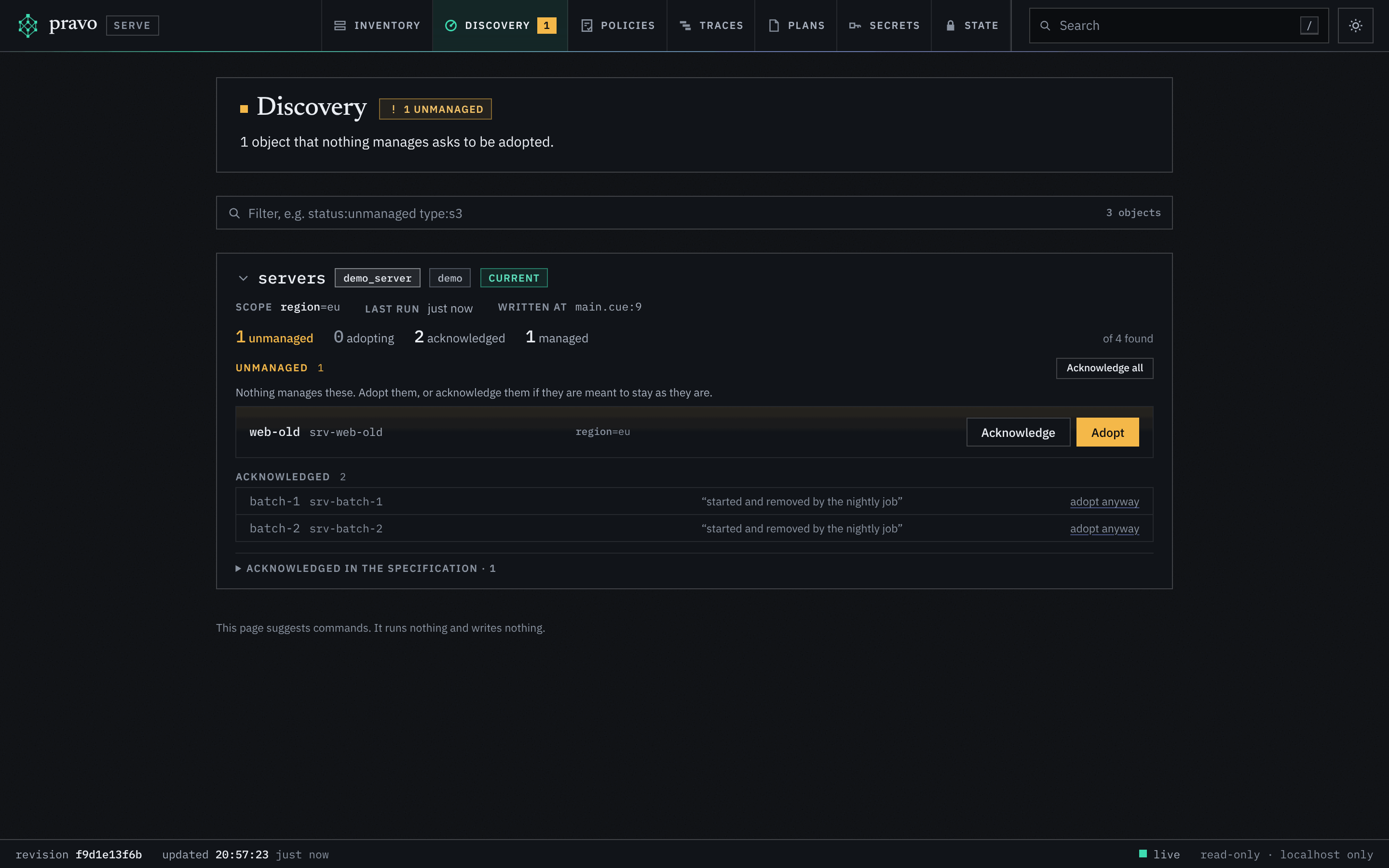
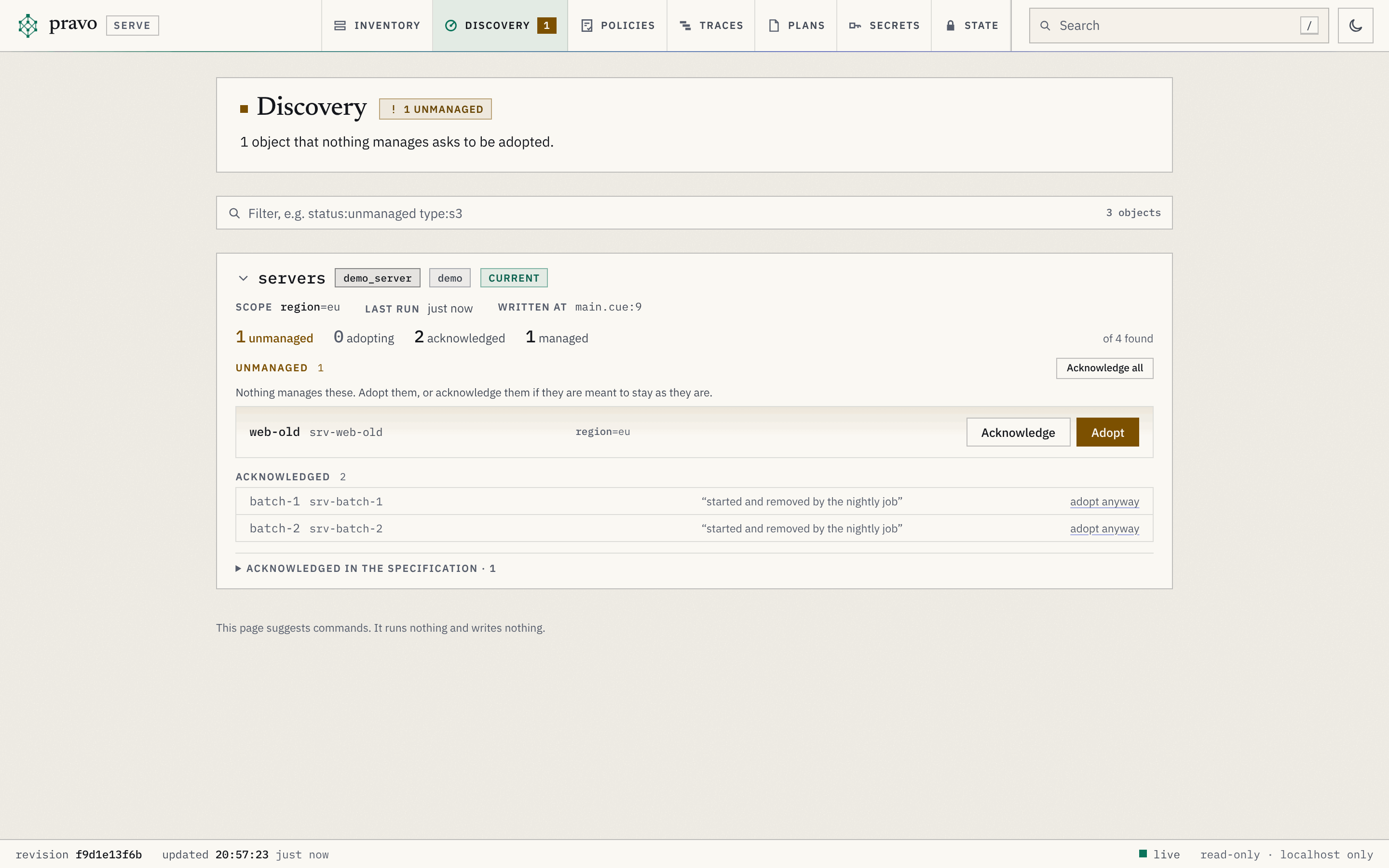
srv-batch-2 batch-2 $ack[0] “started and removed by the nightly job”The viewer shows the same run. Run pravo serve in this directory and press d for the Discovery section: the discovery is a card with its scope, when it ran, and the count of objects by status. The object that nothing accounts for comes first, with a button that opens the resource to adopt it and one that opens the $ack entry to copy. The acknowledged objects follow in grey with their reasons, and the managed one is a number.
Adopt one
web-old is a server that the specification should manage. pravo discover adopt writes the resource that adopts it: a $import with the identity of the object, as B8 wrote one by hand. With --read the provider is asked for the object, and its attributes are written in. tee -a shows the resource and appends it to main.cue.
// Adopts the demo_server "srv-web-old" (web-old) that the discovery servers found.
web_old: $demo.#Resource.demo_server & {
	$import: {
		id:     "srv-web-old"
		region: "eu"
	}
	name: "web-old"
	// secret is sensitive: write its value yourself.
	size: "large"
}The provider gave out the name and the size. It did not give out secret, which is sensitive, and the comment says so. Before any plan reads the object, the discovery knows that something is about to adopt it:
servers  demo_server via demo
  scope: region=eu
  last run <age> ago: 4 objects
  0 unmanaged · 1 adopting · 2 acknowledged · 1 managed

  ADOPTING
    srv-web-old                   web-old  by web_old

  ACKNOWLEDGED
    srv-batch-1                   batch-1  $ack[0] “started and removed by the nightly job”
srv-batch-2 batch-2 $ack[0] “started and removed by the nightly job”Plan, as for any $import. The plan reads the object and sets it against the resource:
web_old: Reading the object of the identity "id=srv-web-old,region=eu"...

pravo will perform the following actions:

  # web_old will be imported from the identity "id=srv-web-old,region=eu" and will be updated in-place
  ~ web_old: {
        id:     "srv-web-old"
        name:   "web-old"
  -     secret: (sensitive)
        size:   "large"
    }

Plan: 0 to add, 1 to change, 0 to destroy, 1 to import.
Graph: planned 1 · skipped 1 · not read 1 · to import 1The server has a secret, and the resource says nothing about one, so the apply would take it away: a resource says everything about its object. Write the value in place of the comment. Every server of the demo provider was made with hunter2.
package main

import demo "pravo.dev/providers/demo/demo"

$demo: demo.#Provider & {$path: "./terraform-provider-demo"}

web: $demo.#Resource.demo_server & {name: "web"}

servers: $demo.#Discovery.demo_server & {
	region: "eu"
	$ack: [{
		names:  ["batch-*"]
		reason: "started and removed by the nightly job"
	}]
}

// Adopts the demo_server "srv-web-old" (web-old) that the discovery servers found.
web_old: $demo.#Resource.demo_server & {
	$import: {
		id:     "srv-web-old"
		region: "eu"
	}
	name:   "web-old"
	secret: "hunter2"
	size:   "large"
}
  # web_old will be imported from the identity "id=srv-web-old,region=eu" and matches the specification
Plan: 0 to add, 0 to change, 0 to destroy, 1 to import.
Apply complete! Resources: 0 added, 0 changed, 0 destroyed. [txn <txn>]The object matches the specification, and the apply wrote its record. pravo discover --all runs every discovery again, current or not. The object is managed now.
servers: listing demo_server...
servers  demo_server via demo
  scope: region=eu
  last run <age> ago: 4 objects
  0 unmanaged · 0 adopting · 2 acknowledged · 2 managed

  ACKNOWLEDGED
    srv-batch-1                   batch-1  $ack[0] “started and removed by the nightly job”
srv-batch-2 batch-2 $ack[0] “started and removed by the nightly job”Check it from a pipeline
Nothing is unmanaged, so the check passes:
Exit code 0. With pravo discover --all before it, this is the check that a pipeline runs: it fails when something was made outside the specification and nobody acknowledged it. Run pravo in a pipeline shows where to put it.
Exercise
A second region
us-one is in us, outside the scope of servers. Declare a second discovery, servers_us, over the region us, run it, and acknowledge us-one by its id with a reason of your own, so that pravo discover show --exit-code exits 0 again.
Hint 1
A root holds any number of discoveries. pravo discover with no name runs the ones that have not run, or whose scope changed, and leaves the current ones alone.
Hint 2
An entry with ids: ["srv-us-1"] matches one object by its id. Patterns work in ids as in names.
Solution
package main

import demo "pravo.dev/providers/demo/demo"

$demo: demo.#Provider & {$path: "./terraform-provider-demo"}

web: $demo.#Resource.demo_server & {name: "web"}

servers: $demo.#Discovery.demo_server & {
	region: "eu"
	$ack: [{
		names:  ["batch-*"]
		reason: "started and removed by the nightly job"
	}]
}

// Adopts the demo_server "srv-web-old" (web-old) that the discovery servers found.
web_old: $demo.#Resource.demo_server & {
	$import: {
		id:     "srv-web-old"
		region: "eu"
	}
	name:   "web-old"
	secret: "hunter2"
	size:   "large"
}

servers_us: $demo.#Discovery.demo_server & {
	region: "us"
	$ack: [{
		ids:    ["srv-us-1"]
		reason: "the archive of the old region, kept until the audit"
	}]
}
servers_us: listing demo_server...
servers_us  demo_server via demo
  scope: region=us
  last run <age> ago: 1 object
  0 unmanaged · 0 adopting · 1 acknowledged · 0 managed

  ACKNOWLEDGED
srv-us-1 us-one $ack[0] “the archive of the old region, kept until the audit”servers is current and did not run.
Clean up
Destroy complete! Resources: 0 added, 0 changed, 2 destroyed. [txn <txn>]Recap
- A discovery lists the objects of one type in a scope and sets them against the state. It manages nothing: no plan reads it, and no apply makes anything from it.
pravo discoverruns the discoveries that have not run or whose scope changed.pravo discover showprints the last run, and--exit-codemakes it exit 2 while an object is unmanaged.- An object is managed when a record holds its identity, acknowledged when an entry of
$ackmatches its name or id, and adopting when a resource names it in$importand has no record yet. The rest is unmanaged. pravo discover adopt NAME ID --readwrites the resource that adopts an object, with the attributes the provider returns. Plan and apply as for any$import.- The Discovery section of the viewer,
d, shows the same run, with the resource that adopts each object and the entry that acknowledges it, to copy.
Check yourself
A discovery ran yesterday. You add an entry to its $ack list today. Does pravo discover run it again?
No. The entries are not part of the scope, so the discovery is current. pravo discover show reads the acknowledgement from the specification against the last run.
Why is the object of web counted and not listed?
A record of the state holds its identity, so it is managed. The listing shows what asks for a decision: the unmanaged objects, and the ones being adopted.
The guide Find what nothing manages adds a change of scope and the filter of the Discovery section. B11 turns to rules about what a plan may do.